
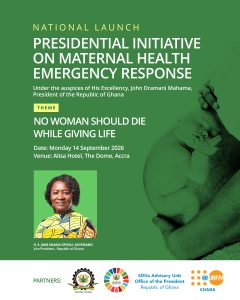
What it is: A five-year national initiative, led by the President, that treats maternal death in Ghana as an emergency
Goal: Reduce maternal deaths to 70 per 100,000 live births by 2030, and move towards zero preventable maternal deaths
Led by: A High-Level Presidential Task Force
Coordinated by: The SDG Advisory Unit, Office of the President
Delivered with: Ministry of Health and Ghana Health Service, Ministry of Finance, National Development Planning Commission, CHRAJ, Regional Coordinating Councils, and UNFPA with the wider UN system
Reach: All 16 regions, 232 districts and municipalities, and 394 paramountcies
THE PROBLEM IN NUMBERS
- 301 — maternal deaths per 100,000 live births in Ghana, 2021. The figure was 310 in 2010 and 760 in 1990.
- 2.9% — the current annual rate of reduction. Reaching the 2030 target requires 16.7% a year.
- 80% — share of maternal deaths that occur just before, during or immediately after delivery.
- 86.7% — share of maternal deaths in tertiary and regional referral hospitals that are among women referred from another facility. More than half die within 24 to 48 hours of admission.
- 54% — share of Ghanaian women who face at least one barrier to reaching health care.
- 71% — share of pregnant women who still pay out of pocket, averaging USD 17, despite the Free Maternal Health Care Policy.
WHO IS DYING, AND WHERE?
Deaths are concentrated in the northern regions and in rural areas, among women aged 30 to 34, and among women in the poorest households. Most occur inside health facilities.
WHY MOTHER DIE
Direct causes: Haemorrhage. Hypertensive disorders, meaning pre-eclampsia and eclampsia. Unsafe abortion and its complications. Sepsis and infections. Ectopic pregnancy and uterine rupture.
Indirect causes: Infections including HIV and AIDS, pneumonia, malaria, meningitis and tuberculosis. Sickle cell disease. Anaemia in pregnancy. Cardiovascular disorders. Chronic liver disease.
Coverage is not the barrier. Antenatal care and skilled birth attendance are both near universal and institutional delivery stands at 86 per cent. Every leading cause is treatable with skills and technology Ghana already has.
THE FIVE PILLARS
- Political leadership: A Presidential Task Force. Presidential directives to all Regional Ministers and through them to every district and municipal assembly. Formal roles for traditional and religious leaders in community mobilisation and health governance.
- Accountability: Maternal death reinstated as a notifiable condition, reported within 24 hours. Facility and community audits of every maternal death. Public league tables ranking regions, districts and facilities. An annual CHRAJ public inquiry reported to Parliament. An annual Maternal Health Summit chaired by the President.
- Sustainable financing: Directives to Finance, Health and the Regional Coordinating Councils to raise allocation. A dedicated Maternal Health Trust Fund within the Mahama Cares Fund, open to citizen, private sector and philanthropic giving. Central procurement of maternal health commodities.
- Maternal Mortality Reduction Accelerated Action and Response Programme (MMARP): The Ministry of Health’s clinical arm, targeting the referral hospitals where more than 70 per cent of institutional maternal deaths occur. Produces a costed National Maternal Mortality Reduction Roadmap for 2026 to 2030.
- Intersectoral coordination: A High-Level Steering Committee, with a Multi-Sector Technical Working Group chaired by the Deputy Minister of Health. Joint planning across health, transport, social protection, gender, local government and finance.
THE INVESTMENT CASE
- 8,606 maternal deaths are projected to be averted between 2024 and 2030, a 64 per cent reduction in the maternal mortality ratio.
- Every USD 1 invested in maternal health returns an estimated USD 22.50. Family planning returns USD 6.90.
- Over USD 8.7 billion in socioeconomic benefits projected by 2030.
- Up to 1.6 per cent of GDP lost to inaction between 2024 and 2030.
- USD 430 million financing gap to deliver the full package of interventions.
THE FINANCING CONTEXT
- Health received between 6.7 and 10.7 per cent of the national budget between 2022 and 2024, against the 15 per cent Abuja Declaration target. Over 90 per cent of domestic health revenue goes to salaries.
- Reproductive health took under 2 per cent of total health spending in 2024.
- Development assistance for health fell from 10 per cent of health financing in 2019 to 2 per cent in 2025.
- Half of health facilities have run out of oxytocin, magnesium sulphate or misoprostol, and 46 per cent have run out of contraceptives. The withdrawal of USAID support leaves 45 per cent of the national contraceptive requirement unfunded, in a country where family planning alone can prevent up to a third of maternal deaths.
KEY DATES
Launch: 14th September, 2026
Year one: Presidential Task Force established. Directives issued to all 16 regions. PRIMER launched across 232 districts. Maternal Health Trust Fund opened.
Reporting: Bi-annual progress reports by the SDG Advisory Unit
Mid-term review: End of 2028
Final evaluation: 2030, at final SDG reporting
RELEVANT TERMINOLOGIES
Maternal mortality ratio (MMR): The number of women who die from pregnancy-related causes per 100,000 live births.
The three delays: The delay in deciding to seek care, the delay in reaching care, and the delay in receiving quality care once there. All three are recognised drivers of maternal death.
MPDSR: Maternal and Perinatal Death Surveillance and Response. The system for reporting, reviewing and acting on every maternal and newborn death.
EmONC: Emergency Obstetric and Newborn Care. Basic (BEmONC) and Comprehensive (CEmONC) refer to the set of life-saving functions, or signal functions, a facility must be equipped and staffed to perform.
Maternal near-miss: A woman who survives a life-threatening pregnancy complication. Reviewing these cases reveals system failures that deaths alone do not show.
Notifiable condition: A condition that must by law be reported to health authorities within a set period, in this case 24 hours.
PRIMER is an initiative of the Sustainable Development Goals Advisory Unit, Office of the President, with the National Development Planning Commission, the Ministry of Health and UNFPA Ghana.